

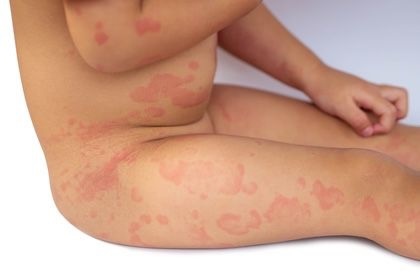
Hives are sometimes accompanied by angioedema, a deeper swelling of the skin or mucous membranes, such as the eyelids, lips or face. In children, hives often develop during an infection and do not necessarily mean an allergy. In most cases, they resolve without serious consequences, but certain symptoms require emergency medical care.
Hives are common in children. They can occur with infections, allergic reactions, exposure to cold, heat, pressure and other triggers.
Characteristic features include:
- itchy welts of different sizes and shapes;
- welts appearing and disappearing quickly;
- the rash moving from one area of skin to another;
- each individual welt usually disappearing within 24 hours without leaving a mark;
- sometimes swelling of the eyelids, lips or other parts of the body.
Hives alone do not mean anaphylaxis. But if breathing difficulties, trouble swallowing, marked weakness, fainting or other signs of a severe systemic reaction occur at the same time, emergency help is needed.
When to call an ambulance immediately
Call an ambulance if the child develops any of the following:
- difficulty breathing or wheezing;
- sudden hoarseness, difficulty swallowing or a feeling of tightness in the throat;
- rapidly increasing swelling of the tongue or throat;
- marked weakness, fainting or an altered level of consciousness;
- sudden pronounced pallor and signs of impaired circulation;
- repeated vomiting or severe abdominal pain together with a rapidly developing allergic reaction, especially after exposure to a suspected allergen.
These symptoms may indicate anaphylaxis, a severe systemic allergic reaction. Anaphylaxis can sometimes develop without hives or any other visible rash.
What to do while waiting for the ambulance
If the child has a previously prescribed adrenaline (epinephrine) auto-injector and develops signs of anaphylaxis, use it immediately according to their individual emergency action plan. Call an ambulance after giving adrenaline, even if the child's condition improves.
If possible, help the child lie down. If they are vomiting, turn them onto their side. If lying down is difficult because of breathing problems, help them into a position in which breathing is easier. Do not let the child suddenly stand up or walk. Antihistamines and glucocorticoids do not replace adrenaline in anaphylaxis.
Do not delay emergency treatment while waiting for an allergy tablet to work.
What hives look like
Hives appear as welts on the skin that may be pink, red or almost the same colour as the surrounding skin. They may be small or merge into larger areas.
Typical hives have the following features:
- the welts are usually very itchy;
- each individual welt disappears within several hours, almost always within 24 hours;
- a disappearing welt does not leave a bruise or scar;
- new welts may appear in other places.
That is why hives can sometimes look as though the rash is "moving" around the body.
When a rash does not look like ordinary hives
Further assessment is needed if:
- the same individual lesion lasts for more than 24 hours;
- the rash is painful rather than just itchy;
- bruising or unusual pigmentation remains after the lesions disappear;
- prolonged fever, marked joint pain or other systemic symptoms develop.
This pattern can occur with other conditions, including urticarial vasculitis and certain inflammatory disorders. It does not mean the child necessarily has a serious illness, but the diagnosis should be reconsidered.
Acute and chronic hives
Acute hives
Hives lasting up to and including 6 weeks are called acute urticaria. In children, they often appear during or after an infection. In most cases, symptoms disappear much sooner, within a few days or weeks.
Chronic hives
If welts, angioedema or both recur for more than 6 weeks, the condition is called chronic urticaria. In chronic spontaneous urticaria, the rash develops without an obvious, persistent external trigger. There are also inducible forms in which symptoms follow a particular stimulus, such as cold, heat or pressure.
Chronic hives are not necessarily caused by food allergy. Eliminating many foods for a long time without an established cause is therefore usually unhelpful.
Why children develop hives
Viral infections
A viral infection is one of the most common causes of acute hives in children. The rash may appear alongside fever, a runny nose or cough, or even as the child begins to recover. In this situation, hives do not necessarily mean the child has encountered an allergen.
Food allergy
Certain foods can indeed trigger hives. With an immediate-type allergic reaction, symptoms usually begin soon after exposure to the food, often within the first few minutes to two hours. The clinician considers whether the reaction happens repeatedly and whether other symptoms are present.
But not every episode of hives after a meal should be considered a food allergy. Timing alone does not establish a causal relationship.
Medicines
Hives sometimes appear while a child is being treated for an infection. However, a rash that develops during antibiotic treatment does not always mean an allergy to that particular medicine. The infection itself or a combination of factors may be responsible.
If a medication reaction is suspected, contact the clinician who prescribed the medicine to discuss further treatment. Emergency care is needed if signs of anaphylaxis develop. A true drug allergy cannot be confirmed or ruled out merely because a rash occurred.
Other triggers
Hives may be triggered by:
- insect stings;
- cold;
- heat;
- pressure or friction against the skin;
- physical activity;
- certain medicines;
- other individual triggers.
Sometimes no specific cause can be identified.
What is angioedema?
Angioedema is a deeper swelling of the skin or mucous membranes.
It most often affects:
- the eyelids;
- the lips;
- the face;
- the hands and feet;
- other areas of the body.
Unlike superficial itchy welts, angioedema may cause tightness, a feeling of pressure or pain. It usually resolves more slowly and can sometimes last up to 72 hours. Not every episode of angioedema is anaphylaxis.
For example, limited swelling of an eyelid or lip without breathing or swallowing difficulties or a change in the child's overall condition does not necessarily mean a severe systemic reaction. However, significant or worsening swelling of the face and lips, especially if it happens for the first time, needs timely medical assessment. If the tongue or throat swells or breathing is affected, call an ambulance immediately.
Angioedema without hives
If a child has repeated episodes of marked swelling without itchy welts, the clinician may consider other disease mechanisms. In rare cases, the cause is hereditary angioedema. This condition can cause recurrent swelling of the skin, abdominal pain and other symptoms. Ordinary antihistamines and glucocorticoids are ineffective for swelling caused by this mechanism.
Recurrent angioedema without hives is therefore a reason to consult a specialist, particularly if relatives have experienced similar episodes.
What tests are needed?
For typical acute hives without other warning signs, a large panel of tests is usually unnecessary. The diagnosis is most often made from the appearance of the rash and the medical history.
The clinician will ask:
- when the rash first appeared;
- how long each individual welt lasts;
- whether the child has a fever or signs of infection;
- which medicines the child is taking;
- whether new foods or other possible triggers were involved;
- whether angioedema has occurred;
- whether any other symptoms are present.
Does the child need allergy testing?
Not everyone does. If the history genuinely suggests a specific allergen, the clinician may recommend targeted testing. Broad food-allergen panels are not usually needed after every episode of hives.
A positive specific-IgE test indicates sensitisation, but on its own it does not prove that a particular food caused the hives.
Tests for chronic hives
If symptoms last for more than 6 weeks, the clinician may recommend a limited set of basic tests and additional investigations when there are specific indications. The choice depends on the symptoms, examination and suspected type of urticaria. There is no single universal laboratory test that identifies the cause of every case of chronic hives.
How symptoms are relieved
If symptoms are limited to the skin and there are no signs of a dangerous systemic reaction, treatment focuses primarily on relieving itching and discomfort.
Antihistamines
First-line medicines are generally modern second-generation H1 antihistamines, such as cetirizine or another age-appropriate medicine. They reduce the effects of histamine and help control itching and the appearance of welts.
The particular medicine, dose and duration are chosen based on the child's age, the medicine's authorisation and other medical factors. With chronic urticaria, a clinician may sometimes adjust the treatment regimen if the usual dose is not effective enough. Do not increase the dose or combine several medicines without medical advice.
Glucocorticoids
Systemic glucocorticoids are not standard treatment for every episode of hives. In certain severe cases, a clinician may consider a short course, but prolonged use for chronic urticaria is not recommended. Swelling alongside welts does not automatically mean that a child needs steroid medicines.
What you can do at home
The following may help reduce discomfort:
- applying a cool compress;
- wearing loose clothing that does not rub against the skin;
- avoiding overheating;
- reducing exposure to a known, confirmed trigger.
Do not start a strict "hypoallergenic" diet or eliminate many foods without an established reason. If the hives are mild and do not bother the child, medication may sometimes not be needed at all.
When to see a doctor
See a paediatrician if:
- the rash persists for several days without improving;
- hives keep returning;
- marked angioedema develops;
- the rash is accompanied by fever, joint pain or unusual bruising;
- the same individual welt lasts more than a day;
- a reaction to a medicine is suspected;
- symptoms appear for the first time in an infant younger than 6 months;
- the recommended treatment is not helping.
If hives persist for more than 6 weeks, an allergist-immunologist consultation can help clarify the type of urticaria and the next steps. Recurrent swelling without welts also needs specialist assessment. If breathing, swallowing or consciousness is impaired, or other signs of anaphylaxis develop, do not wait for a scheduled appointment: call an ambulance.
Frequently asked questions and myths
Do hives always mean an allergy?
No. In children, acute hives often occur during infections, and there may be no specific allergen.
If hives appear during antibiotic treatment, does that mean the child is allergic?
Not necessarily. A rash during treatment may be related to the infection or to a medication reaction. The clinician needs to assess the circumstances before drawing a conclusion.
Should every allergy test be done immediately?
Usually not. Tests are selected based on the clinical history and suspicion of a specific cause.
Should sweets, milk, eggs and other foods be eliminated?
Foods should not automatically be eliminated without a proven connection to the symptoms. Unnecessary dietary restrictions are particularly undesirable in young children.
Can hives continue for several weeks?
Yes. Acute hives can last for up to 6 weeks. If symptoms recur for longer, the condition is classified as chronic urticaria and the diagnostic approach is reconsidered.
Does angioedema always require an ambulance?
No. Limited, isolated swelling without danger signs does not necessarily mean anaphylaxis. However, increasing swelling of the tongue or throat, or difficulty breathing or swallowing, requires immediate emergency care.
Can antihistamines treat anaphylaxis?
No. Adrenaline (epinephrine) is the first-line treatment for anaphylaxis. Antihistamines do not replace it and must not delay emergency treatment.
Key point: Hives in children are often temporary and are not always caused by an allergy. Assessing the symptoms and treating itching appropriately is usually sufficient. But if breathing, swallowing or circulation is affected, call an ambulance immediately.